Santoku or chef’s knife –
which is really right for you?
The most frequently asked question when buying a kitchen knife – and the answer is simpler than you might think. An honest comparison without marketing language.
Santoku or chef’s knife – this question comes up with almost every knife purchase. Both knives can cut meat, fish and vegetables. Both are useful in any kitchen. But they do it differently – and depending on how you cook, one of them will suit you considerably better.
The fundamental difference
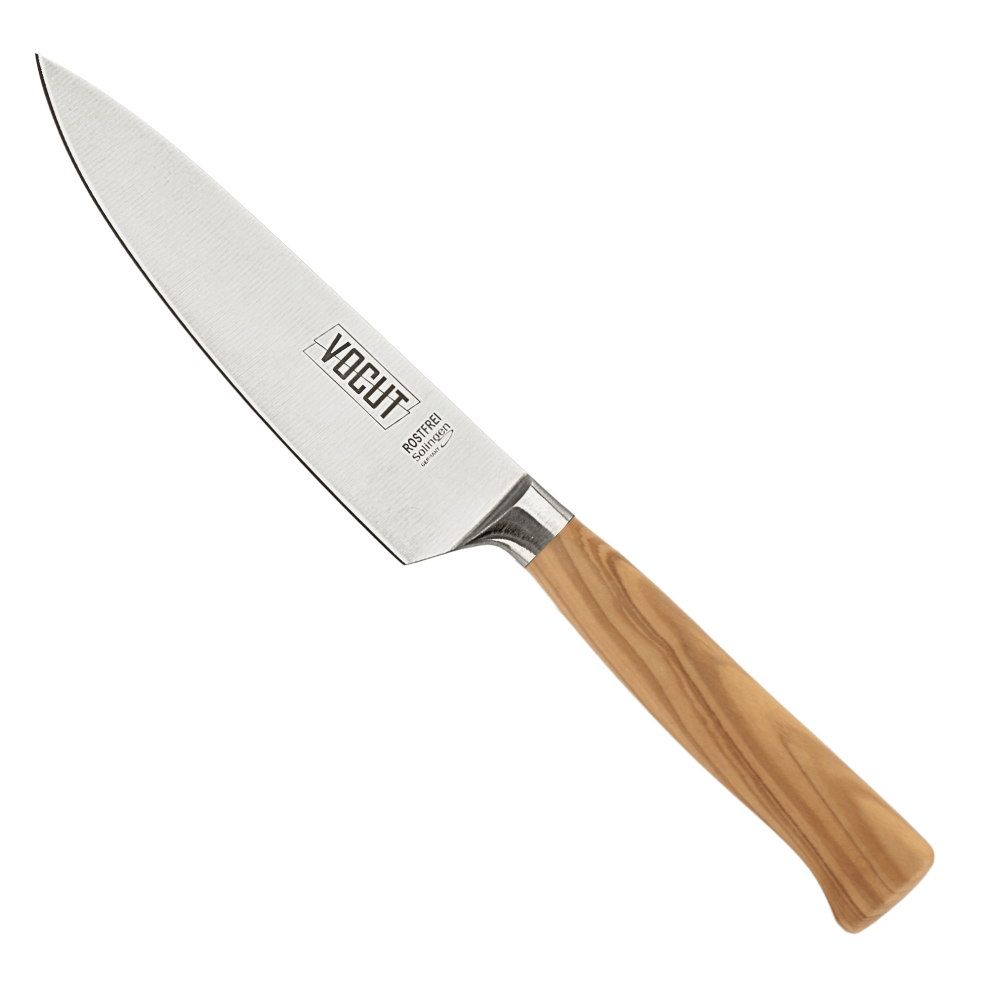
The chef’s knife is the European all-purpose knife. It has a broad, slightly curved blade that allows the rocking motion – the blade tip stays on the board while the handle rocks up and down. Fast, efficient and intuitive for anyone who cooks in a European style.
The santoku comes from Japan and means “three virtues” – meat, fish, vegetables. It has a straight, tall blade without a curved belly. The preferred technique is the push cut: the knife is pressed straight down and pushed slightly forward. This produces more uniform, thinner slices – ideal for vegetables and fish.
The chef’s knife – European classic
The chef’s knife (20–25 cm) is the world’s best-selling kitchen knife – for good reason. The curved blade allows fast chopping and rocking, the width provides stability when cutting meat, and the length enables gliding cuts through large pieces.
The chef’s knife is ideal for you if you:
- Process a lot of meat and poultry
- Want to work quickly using a rocking motion
- Cut larger quantities in a short time
- Are looking for a single versatile knife
The santoku – Japanese alternative
The santoku (14–18 cm) is shorter and lighter than a chef’s knife – which makes it especially handy. The flat blade without a belly curve lies fully on the board and produces evenly thin slices with the push cut. Many cooks with smaller hands prefer the santoku because it feels more precise.
The santoku is ideal for you if you:
- Cut a lot of vegetables and fish
- Need uniform, thin slices
- Prefer a lighter, more compact knife
- Work with a push cut or want to learn it
Direct comparison
| Santoku | Chef’s knife | |
|---|---|---|
| Blade length | 14–18 cm | 20–25 cm |
| Blade shape | Straight, tall blade | Curved, with belly |
| Cutting technique | Push cut | Rocking motion |
| Cutting vegetables | ✓ Excellent | ✓ Good |
| Cutting meat | ✓ Good | ✓ Excellent |
| Large quantities | Limited | ✓ Excellent |
| Weight | Lighter | Heavier |
| Manoeuvrability | Very handy | Slightly larger |
| For beginners | ✓ Ideal | ✓ Classic choice |
Our clear recommendation
Cook a lot of vegetables and fish → santoku.
Not sure yet → santoku, because it is more beginner-friendly.

Why not both? The perfect duo
Many cooks who start with a santoku later add a chef’s knife – and vice versa. Together they cover everything. Our 5-piece knife set includes both and is the most economical option:
Both knives – direct from Solingen
Free shipping · 60-day returns · Lifetime resharpening service
Discover all knives To the FAQ