Anyone in Germany looking for a high-quality kitchen knife inevitably comes across the name Solingen. The City of Blades in North Rhine-Westphalia is considered a synonym for precision, sharpness and durability worldwide. But not everything that says “Solingen” was actually made there. If you want to buy a genuine Solingen knife, you should know a few things.
What does “Made in Solingen” really mean?
The name “Solingen” is legally protected for cutlery. The protection goes back to a law from 1938; today the Solingen Ordinance of 1994 applies. It stipulates that knives, scissors and other cutlery may only be marketed as “Solingen” if they have been processed and finished in all essential production stages in the Solingen industrial area – i.e. in Solingen or neighbouring Haan. A knife made in the Far East that is merely packaged in Solingen or given a Solingen label may not bear the name.
Important: it is not only the phrase “Made in Solingen” that is protected, but the name itself. “Solingen quality” or “from Solingen” may also only appear on knives that were actually made there.
- Phrases such as “Design Solingen” or “designed in Solingen”
- the claim “Solingen steel” – no steel is produced in Solingen today
- slightly altered spellings of the place name
- no manufacturer and no address on the goods or packaging
- strikingly high discounts on supposedly expensive knives
Anyone who misuses the name can be issued a cease-and-desist letter and sued. This makes “Solingen” one of the most reliable quality signals when buying a knife – if you know what to look for.
VOCUT makes all knives entirely in Solingen – from hardening and grinding to the final hand finishing of the edge. Our olive wood handles are also sawn from solid blocks of wood and fitted to each blade.
What should I look for when buying a Solingen knife?
At best, a good kitchen knife will accompany you for a lifetime. These five criteria decide whether the purchase is an investment or a disappointment:
- Steel quality – 55–60 HRC is the Solingen standard
- Production – forged beats stamped
- Balance – the knife should rest horizontally at the bolster
- Handle material – olive wood, walnut or POM plastic
- Origin – genuine “Solingen” with manufacturer and address
The right steel – what do the numbers say?
When buying a knife, you come across terms such as 1.4116, X50CrMoV15 or 56 HRC. What is behind them?
One of the most widely used knife steels is steel 1.4116 (X50CrMoV15) – a stainless steel that is usually hardened to 56–58 HRC for kitchen knives. It offers a very good combination of sharpness, robustness and ease of care for the household. Higher hardness means longer edge retention, but also more brittleness. The range of 56–58 HRC is not a compromise but ideal for everyday cooking.
The decisive difference with the same steel: the heat treatment. Solingen companies have been refining hardening and tempering for generations. The same steel recipe, treated differently, results in a fundamentally different knife.
All VOCUT knives are made of steel 1.4116 / X50CrMoV15 and hardened to 56–58 HRC – the proven Solingen standard.
Forged vs. stamped knives – what is the difference?
This question largely determines quality and durability. Forged knives are made by heating a steel blank to around 1,100 °C and shaping it under high pressure. This compacts the steel structure, creates an integrated bolster and gives the knife a natural balance.
Stamped knives are punched out of a steel sheet. They are lighter and cheaper – perfectly suitable for getting started. For daily, intensive use, investing in a forged knife is worthwhile.
VOCUT offers both variants: the forged premium series with olive wood handles and the entry-level series for everyone who wants to test the quality first.
Olive wood handle – the VOCUT hallmark
Olive wood is one of the densest and hardest woods for knife handles. No two handles look alike – the natural grain makes every knife unique. VOCUT does not buy in ready-made handles: they are sawn from solid blocks of olive wood, shaped in Solingen and fitted exactly to each blade.
The result: a play-free, stable connection between handle and blade – and a knife that becomes more and more beautiful over time, because olive wood naturally darkens.
Our recommendations – the best knives from Solingen
The right knife for every need – all made entirely in Solingen, all with olive wood handles:
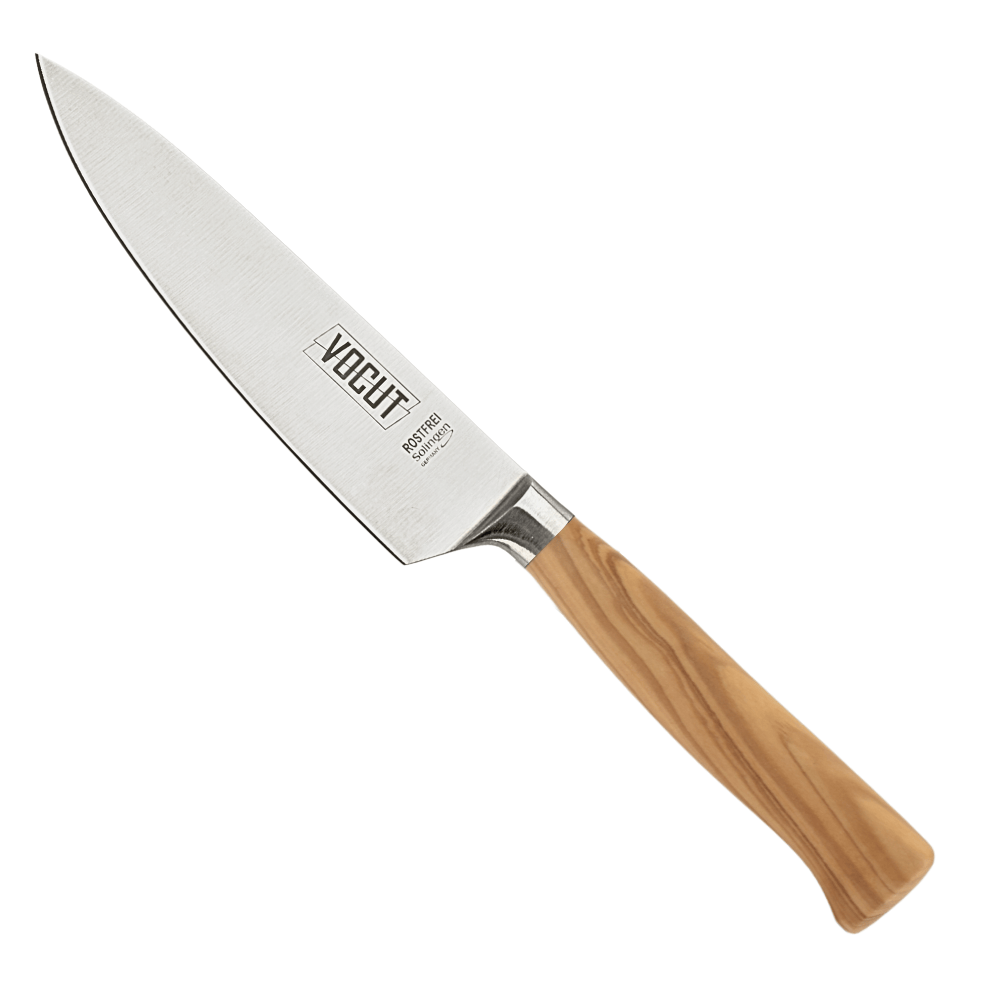 Bestseller Chef’s knife 21 cm · forged €129.90
 Ideal for beginners Santoku 16 cm · forged €89.90
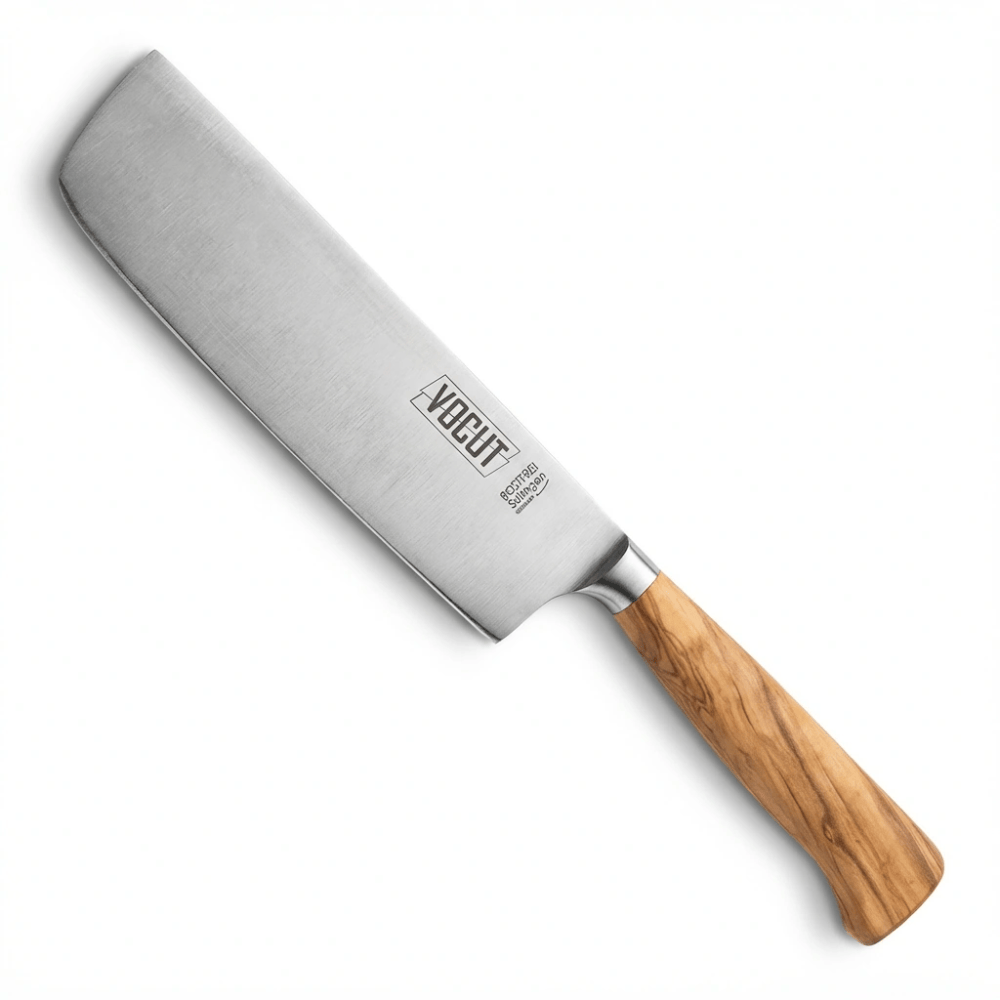 Vegetable pro Nakiri 16 cm · forged €97.00
 Complete set 5-piece knife set · olive wood €399.00
Care – so that the knife lasts a lifetime
A Solingen knife is an investment. With proper care it lasts for decades – and can even be passed on to the next generation. The most important rules:
- Never in the dishwasher – heat and detergents permanently damage steel and wood
- Wash immediately after use – especially after acids (lemon, tomatoes, vinegar)
- Cut on a wooden or plastic board – never on glass, ceramic or stone
- Oil the olive wood handle regularly – with linseed oil, mineral oil or cutting board oil
- Hone regularly with the honing steel – this keeps the edge sharp for longer
And if the knife goes dull despite all the care: we resharpen forged VOCUT knives free of charge for life – no matter where you bought them. You send in the knife, we professionally resharpen it in Solingen and send it back. You only pay for shipping. We sharpen non-forged knives and knives from other brands for a fee.
→ More about the resharpening serviceFrequently asked questions about buying knives in Solingen
How do I recognise a genuine Solingen knife?
Is a Solingen knife worth it compared to a cheap supermarket knife?
Which knife from Solingen should I buy as a beginner?
Can I buy Solingen knives online?
All VOCUT knives – made entirely in Solingen
Direct from the manufacturer · Free shipping from €100 · 60-day returns · Lifetime resharpening service for forged knives
Discover all knives To the VOCUT FAQ