Knife Steel 1.4116 – What’s Behind It?
Why steel is the most important part of a knife – and what X50CrMoV15, HRC values and chromium content mean in practice.
Why steel is the most important feature of a kitchen knife
When people buy a kitchen knife, they often talk about design, handle and brand. But what really matters is the steel. It determines how sharp the knife gets, how long it stays sharp, how easily it can be resharpened – and how easy it is to look after.
VOCUT knives from Solingen are made from 1.4116 steel, also known as X50CrMoV15. It is the most widely used knife steel in European kitchen knives – and for good reason.
What do “1.4116” and “X50CrMoV15” mean?
“1.4116” is the material number under the European standard. The designation “X50CrMoV15” describes the chemical composition:
- X: High alloy content (stainless steel)
- 50: 0.50 % carbon – responsible for hardness and edge retention
- Cr: Chromium – makes the steel rust-resistant
- Mo: Molybdenum – increases hardness and corrosion resistance
- V: Vanadium – refines the grain structure and improves toughness
- 15: 15 % chromium – high rust resistance
What does HRC mean – and why is 56–58 HRC ideal?
HRC stands for Rockwell hardness, scale C – the unit used to measure the hardness of steel. The higher the HRC value, the harder the steel.
Kitchen knives have a sweet spot: too soft (below 54 HRC) means the knife blunts quickly. Too hard (above 62 HRC) means the blade is brittle and difficult to resharpen.
VOCUT knives are hardened to 56–58 HRC. That’s the range which:
- Offers good edge retention (knives stay sharp longer)
- Is easy to resharpen – with a honing steel or whetstone
- Is tough enough for everyday use
- Strikes a good balance between sharpness and toughness
1.4116 steel compared with other knife steels
Compared with German and European steels: 1.4116 is one of the top-tier stainless steels for kitchen knives. It is comparable to the steels used by makers such as Zwilling or Wüsthof.
Compared with Japanese steels: Premium Japanese steels (e.g. AUS-10, VG-10) reach higher hardness (60–65 HRC) and therefore sharper blades. In return, they are more brittle and need more care. For everyday home cooking, 1.4116 is the more practical choice.
Compared with cheap steels: Budget knives from supermarkets or no-name sets often use softer steels below 50 HRC. These knives blunt quickly and are hardly worth resharpening.
Conclusion
1.4116 steel isn’t a compromise – it’s a deliberate choice for a knife that is sharp, stays sharp for a long time and is easy to resharpen. Exactly what an everyday kitchen knife needs to do.
You’ll find more technical terms in our Knife Glossary. Our FAQ answers questions about our knives.
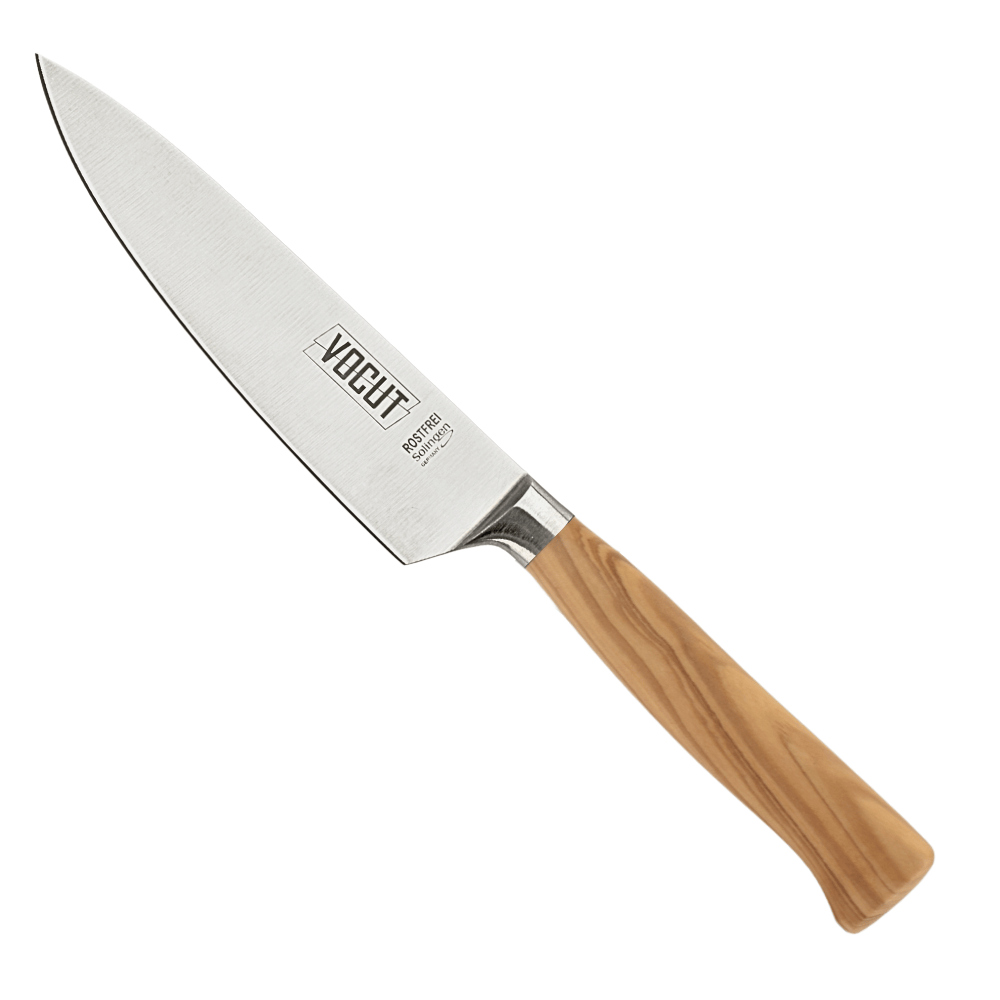
All VOCUT knives at a glance – every knife made from the same proven knife steel.