The VOCUT Knife Dictionary – All Kitchen Knife Terms Explained
The VOCUT
Knife Dictionary
All technical terms about kitchen knives – from knife types and steel grades to Solingen tradition. Clearly explained, with links to the matching knives.
Knife Types & Uses
16 entries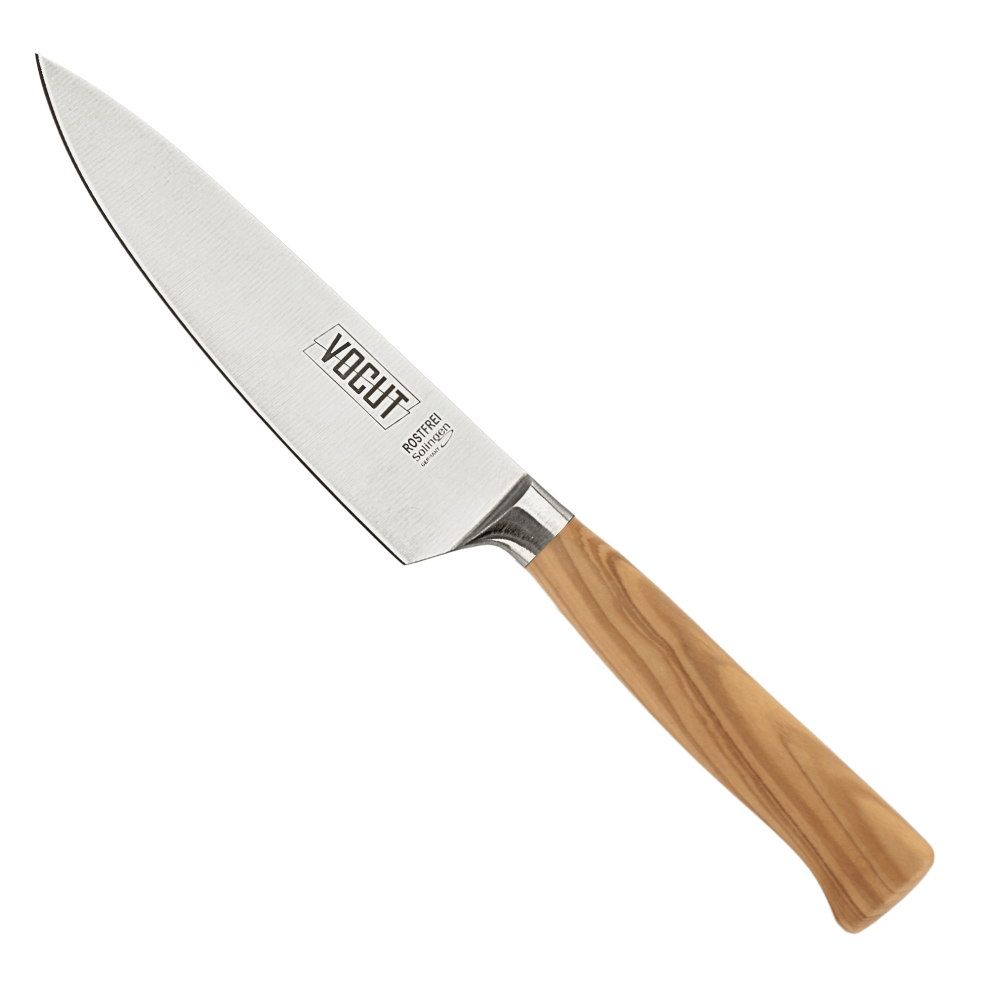
The chef's knife is the most-used knife in both home and professional kitchens worldwide. The characteristic curved edge enables the rocking motion: the tip stays on the board while the handle rocks up and down. This technique allows fast, efficient chopping without effort.
Blade lengths at a glance:
- 6 inches (16 cm): Compact, ideal for smaller hands or confined kitchens
- 8–9 inches (20–21 cm): The classic standard length for home cooks
- 10 inches (25 cm): Professional range, for large quantities and thick ingredients
A good chef's knife is recognised by balanced weight distribution at the bolster – neither tip nor handle should pull down.

The name describes the three uses: fish (sakana), meat (niku) and vegetables (yasai). Compared to the European chef's knife, the Santoku has a wider and flatter blade with less curve. This makes it ideal for the straight, vertical push cut.
Typical characteristics:
- Blade length: 6–7 inches (more compact than a chef's knife)
- Flat edge – no rocking motion possible
- Wide blade acts as a spatula to transport cut ingredients
- Often with Granton edge (hollow ground) to prevent sticking
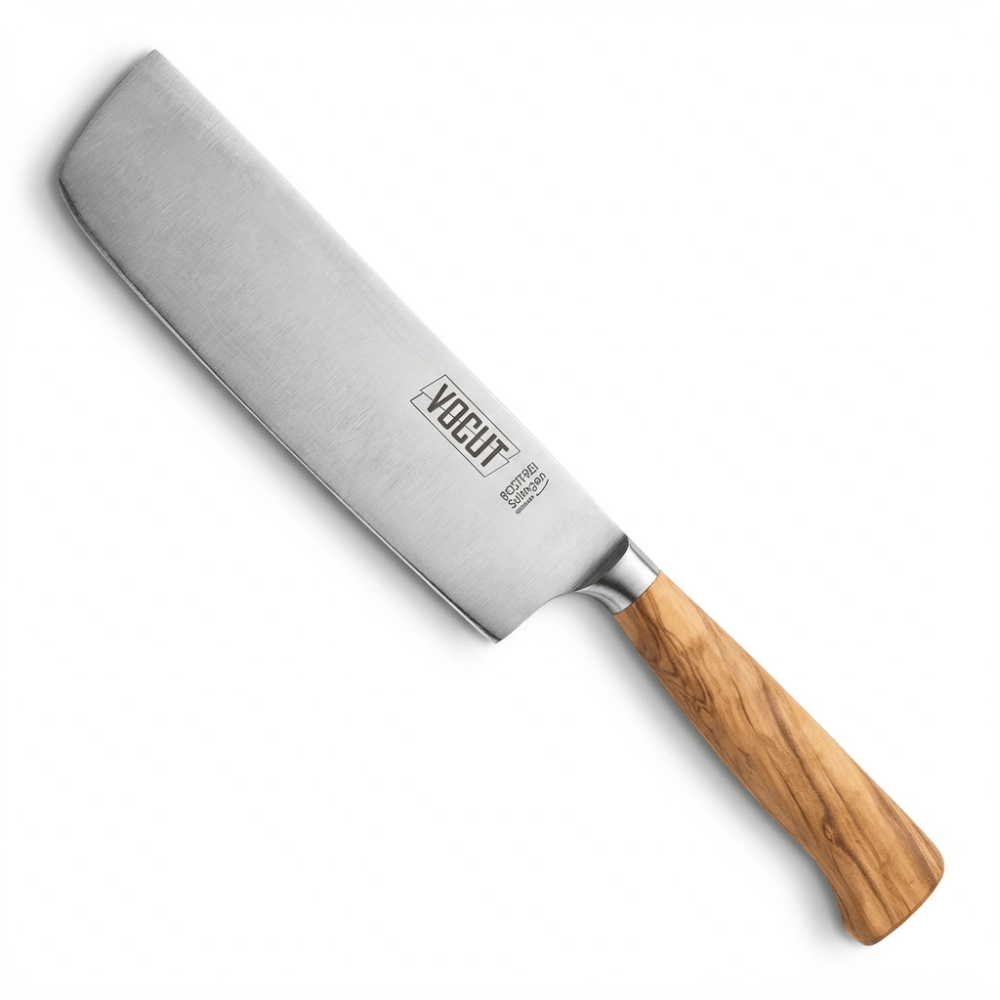
The blunt tip is intentional – not a design flaw. The Nakiri is a pure cutting knife, not a piercing tool. The wide blade acts as a spatula: cut vegetables rest on it and can be pushed directly into the pan.
Advantages:
- Wide blade transports ingredients directly to the pot
- Straight edge – no lifting needed, even slices throughout
- Reduced injury risk due to absent tip
- Ideal for thin, precise slices
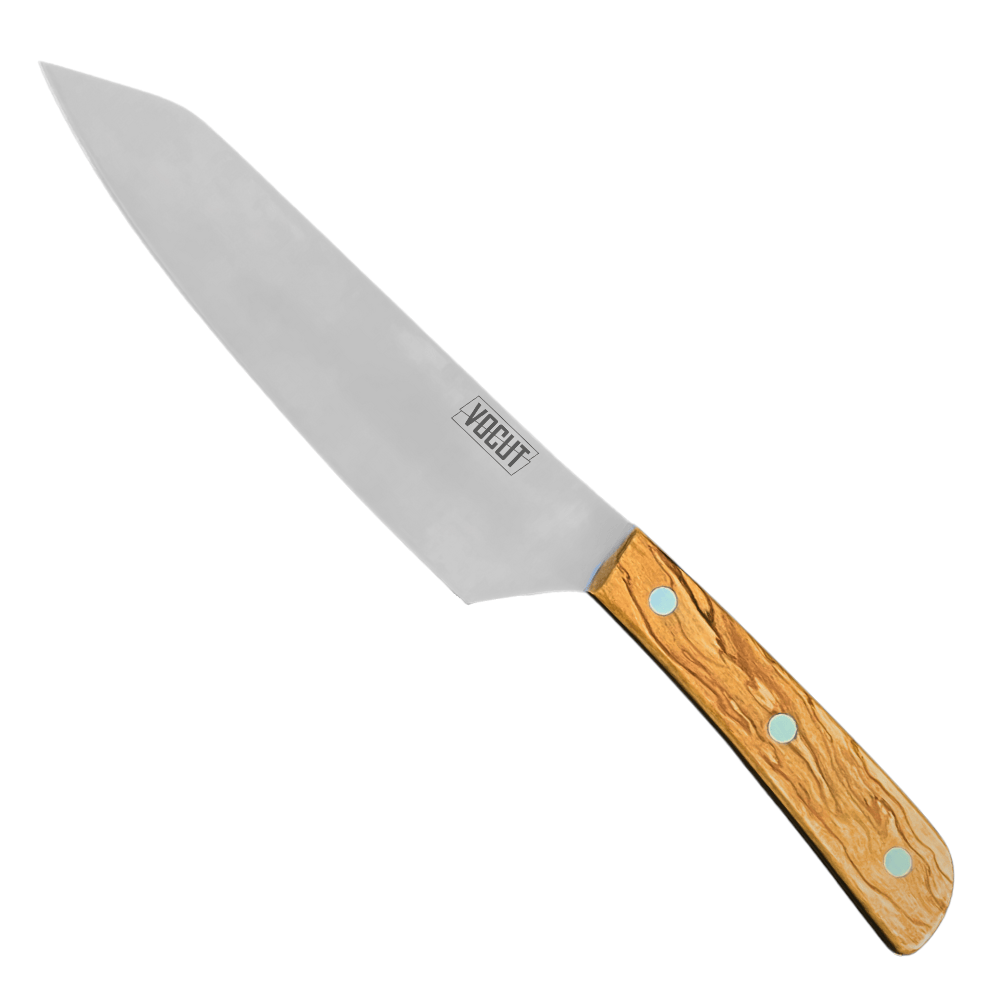
In traditional Japanese kitchens, only the head chef (Itamae) was permitted to use the Kiritsuke – it was a symbol of mastery. Today it is accessible to ambitious home cooks too.
The K-tip allows both precise tip work and the wide-surface cutting typical of the Nakiri, combining the capabilities of several knife types in one.

The serrated edge was invented in 1926 by Karl Güde in Solingen – a revolution in bread cutting. Before this invention, cutting fresh bread required considerable pressure which crushed it.
A bread knife is also perfect for: tomatoes, pineapple, watermelon, squash, and cakes with a hard sugar crust. Downside: almost impossible to sharpen yourself – professional service needed.

It is the third essential knife after the chef's knife and bread knife. Where the chef's knife is too large and unwieldy, the paring knife excels. Typical tasks:
- Peeling and trimming fruit and vegetables
- Finely mincing garlic
- Deseeding chillies
- Garnishing and decorating
- Small precision cuts between larger tasks

A steak knife with a smooth edge cuts meat rather than tearing it. Result: less meat juice escapes, the cut is cleaner and the flavour experience is noticeably better. As a set of 4 or 6, the ideal table presentation for grill evenings.

The long blade enables gliding cuts in a single stroke through large pieces of meat – no sawing, no readjusting. This prevents the typical shredding that occurs when using a short knife.
In professional use, robustness and hygiene matter more than aesthetics. Colour-coded plastic handles (red for raw meat, blue for fish, green for vegetables) prevent cross-contamination according to HACCP standards.
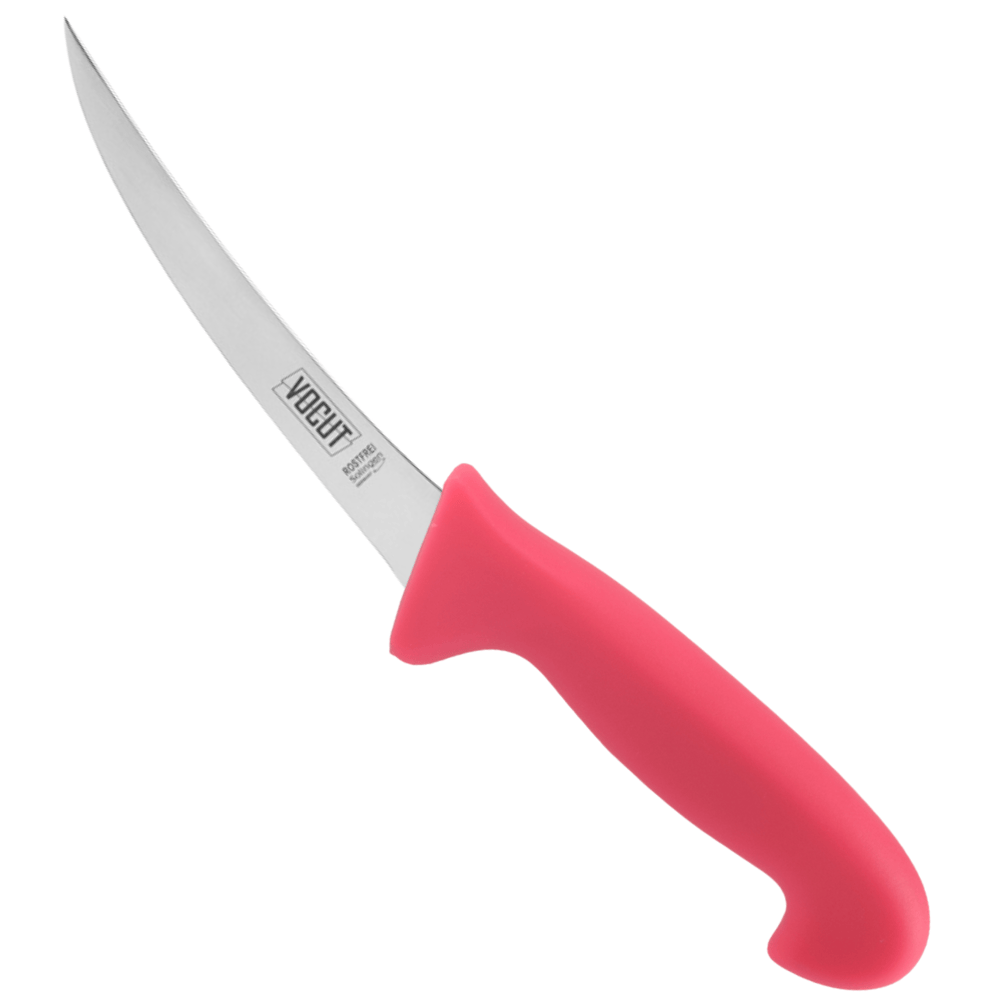
The curved version follows the contours of bones and allows fluid movement when removing meat. The straight version offers more control for precise, linear cuts. Both are indispensable in butchery and professional meat preparation.
The flexibility of the blade is the defining feature: it follows the contours of the fish rather than cutting in a rigid straight line. A stiff knife would leave significantly more flesh on the bone. Also indispensable for paper-thin meat slices and skinning.

Despite the similar shape, cleavers and mezzalunas have different roles. The meat cleaver is built for robustness and breaks bone. The rocking chopper (Wiegemesser) has a curved blade that rocks on the board – ideal for herbs, garlic or onions.
Unlike the chef's knife, the carving knife is not a multi-purpose tool – it is designed exclusively for elegant slicing at the table or in the kitchen. The narrow blade reduces friction and enables paper-thin, even slices in a single long gliding stroke.

Better to own three genuinely excellent knives than twelve mediocre ones. A chef's knife for everything larger, a paring knife for fine work, a bread knife for anything with a hard crust or skin. Anyone who processes a lot of vegetables adds a Santoku or Nakiri – that's all.

It combines elements of the chef's knife and boning knife: wide enough for stable cuts, narrow enough for precise guidance along bones. Standard in butcheries and professional kitchens.
Rocking motion: The knife tip stays on the board, the handle rocks up and down. Fast and efficient for herbs, onions, vegetables. Requires a curved blade (chef's knife).
Push cut: The knife is pushed straight down and slightly forward. Ideal for thin, even slices. Standard technique for Santoku and Nakiri.
Pull cut: The knife is drawn in a long pulling motion. For bread, roasts and large cuts of meat. Serrated and carving knives work this way.
Steel Knowledge
10 entriesThe designation explained:
- X50: 0.5% carbon content – determines hardness and edge retention
- Cr: Chromium (14–15%) – makes the steel stainless
- Mo: Molybdenum – increases toughness and corrosion resistance
- V: Vanadium – forms fine carbides, improves the cutting edge
- 15: 15% total alloying content
The decisive quality difference with identical steel: the heat treatment. Solingen workshops have centuries of experience hardening blades – the result is better than identically labelled steel produced elsewhere.
Rockwell hardness measures a material’s resistance to indentation. For knives:
- 50–54 HRC: Soft – cheap supermarket knives, dulls quickly
- 55–58 HRC: Solingen standard – good for everyday, easily resharpenable
- 59–62 HRC: High quality – long-lasting edge, slightly more brittle
- 63–66 HRC: Japanese premium – extremely sharp, chips under lateral pressure
Important: Higher hardness does not automatically mean “better”. For home kitchens, 56–58 HRC is the best balance of sharpness, robustness and ease of maintenance.
The most common misconception when buying knives: “More Damascus layers = better”. Reality: in most Damascus knives, the Damascus layers are only the outer cladding – pure decoration. The actual cutting steel in the core (e.g. VG-10 or X50CrMoV15) determines performance.
Genuine full Damascus (all layers are cutting steel) is expensive and rare. Budget knives under €100 with “67-layer Damascus” labelling almost always have only decorative outer layers.
The term “stainless” is technically imprecise – “corrosion-resistant” would be more accurate. Even stainless steel can rust under unfavourable conditions: prolonged wet storage, dishwasher use, acid contact without subsequent cleaning.
How the protection works: Chromium reacts with oxygen to form chromium oxide (Cr²O³) – a hard, transparent layer that protects the steel from further oxidation and self-regenerates when damaged.
A knife with good edge retention needs less frequent sharpening. Influencing factors:
- Steel hardness (HRC): Harder steel = better retention, but more brittle
- Sharpening angle: Smaller angle = sharper but shorter lasting
- Cutting boards: Wood protects the blade, glass destroys it immediately
- Cutting technique: Lateral pressure dulls the edge quickly
Carbon steel is the traditional Japanese knife steel. Its fine crystalline structure enables a thinner, sharper edge. The downside: without chromium, there is no protective layer against corrosion. The knife must be dried immediately after every use and oiled regularly.
For everyday German kitchen use, stainless steel (1.4116) is usually the more practical choice. Carbon steel is better suited to passionate cooks using Japanese techniques.
Ceramic knives have not established themselves in professional kitchens – the main reason: the breakage risk. While a steel knife bends under lateral pressure, the ceramic blade snaps like porcelain. Shards in food are the feared consequence.
The main blade cross-sections:
- V-grind (convex): Classic, robust, easily resharpenable
- Flat grind: Thinner, sharper, less robust – typical of Japanese knives
- Hollow grind / Granton edge: Spherical hollows reduce ingredient sticking
- Single bevel: Japanese tradition – only for right- or left-handed use
- Chromium (Cr): From 13% makes steel stainless. Standard in all Solingen knives.
- Molybdenum (Mo): Increases toughness and corrosion resistance at higher temperatures.
- Vanadium (V): Forms vanadium carbides – extremely hard, improves cutting edge and wear resistance.
- Carbon (C): Primary factor for steel hardness. More C = harder but also more brittle.
Good balance significantly reduces fatigue during extended cutting. A blade-heavy knife tires the wrist. A handle-heavy knife gives less feel for the edge.
Test: Rest the knife horizontally on one finger at the bolster. A well-balanced knife stays stable without tipping.
Manufacturing & Craft
9 entriesForging is the oldest and qualitatively superior method for knife blades. In Solingen hand-forging, a knife passes through up to 55 manual steps – each performed individually by an experienced craftsman.
Advantages of forged knives:
- Blade and handle formed from a single piece of steel (full tang)
- More uniform steel grain through densification
- Integral bolster (not a separate added part)
- Better balance and feel in the hand
- Significantly more durable than stamped knives
Stamping is an industrial mass-production process: a thin steel sheet is punched into a blade shape, then ground and hardened. The result is a lighter knife without a bolster – cheaper but less durable than forged blades.
For kitchen beginners or as backup knives, stamped knives are entirely adequate. Those who cook regularly and intensively benefit from upgrading to forged quality.
The process in detail:
- Hardening: Heat steel to austenitising temperature (~1050°C), then rapidly cool (quench) – this “freezes” the hard martensite structure
- Tempering: Re-heating to 150–250°C reduces brittleness without losing much hardness
Here lies a decisive quality difference: the heat treatment is the greatest lever for the final result with identical steel. Solingen workshops have optimised these parameters for generations – this cannot be replicated.
The bolster serves three functions: it protects the finger from slipping onto the blade (finger guard), it adds weight to the handle area (balance), and it reinforces the vulnerable transition zone (stability).
In stamped knives, a bolster is usually glued on afterwards or omitted entirely – a visually recognisable quality indicator when buying.
On a full tang knife you can see the blade metal peeking through the handle scales at the rivet holes. This is a direct quality signal. Knives where the steel only extends a short way into the handle (rat-tail tang) are less stable and durable.
Laser engraving differs from chemical etching through significantly greater precision and permanence. While etched engravings can fade over time, the laser engraving is permanently embedded in the metal.
Possible engraving content: Names, initials, dates, short messages, logos, symbols, coordinates. Maximum 1–2 lines for best legibility.
An experienced grinder feels and sees irregularities that a machine cannot detect. This makes the difference between a good and an excellent blade – and is why the Solingen tradition of hand finishing is so valued.
In commercial kitchens, butcheries and slaughterhouses, colour coding of knives is legally required or at least industry standard. A knife that has been used for fish must not be used for raw meat without thorough cleaning.
The visible rivets on knife handles are a quality signal: they show that the handle is mechanically (not just glued) fastened. Lower quality knives have glued-on handles without rivets – these loosen over time.
On olive wood handles, the rivets are also visually attractive: brass or stainless steel rivets in natural wood give the knife a handcrafted character.
Solingen & Origin
6 entriesThe designation is protected by the Solingen Act of 1938 (updated 1994) and monitored by the Solingen Cutlery Makers Guild. Violations are regularly prosecuted in the courts.
What is permitted: All essential steps in Solingen – forging, hardening, grinding, sharpening.
What is not sufficient: Packaging a Far Eastern knife in Solingen and labelling it “Solingen”. This is illegal.
The special conditions for knife-making in Solingen: the water-rich rivers of the Bergisches Land powered grinding mills for centuries. The knowledge of the knife-makers was passed down and refined through generations.
Today Solingen is home to traditional brands including Güde, Wüsthof, Zwilling, Herder and VOCUT. The city is recognised worldwide as synonymous with the highest knife quality.
Solingen knives (European tradition):
- 55–60 HRC – good edge retention for everyday use
- Stainless – no special maintenance programme needed
- Resharpenable with a standard honing steel
- Robust against lateral pressure; rocking motion possible
Japanese knives:
- Often 60–65+ HRC – longer edge retention
- Often carbon steel – rusts, requires intensive care
- Only sharpenable with diamond or water stones
- Chips under lateral pressure – no rocking motion!
VOCUT is not an anonymous corporation but a personal story. The olive wood handles are sawn and shaped from solid wood blocks in-house – not purchased as standard parts. Every handle is unique.
This service is an expression of a conviction: quality for life. A VOCUT knife never needs to be thrown away. Even after decades of intensive use it can be fully restored through professional sharpening in Solingen.
The service applies without time limit, without quantity restrictions – and even if the knife is passed on to the next generation.
Violations are not treated lightly: companies that use “Solingen” on imported knives have been successfully prosecuted on numerous occasions. The Solingen Act has also served as a model for other protected designations of origin in Germany and Europe.
Unlike some other origin designations, “Made in Solingen” does not simply require the presence of individual production steps – the essential manufacturing steps must actually take place there.
Handle Materials
7 entriesProperties of olive wood:
- Very hard and dense – resistant to impacts
- Natural antibacterial effect through high oil content
- No two handles look the same – every grain is unique
- Warm in the hand, natural grip even when slightly damp
- Darkens over time – becomes more beautiful with care
Care: Never in the dishwasher. Oil monthly with linseed, mineral or olive oil. Dry immediately after use.
Oil comparison:
- Linseed oil (cold-pressed): Best care result – polymerises and forms a protective layer. 24h drying time. Use in good ventilation.
- Mineral oil / baby oil: Never goes rancid, food-safe, easy to apply. Ideal for regular maintenance.
- Cutting board oil: Specifically designed for food contact. Highly recommended.
- Olive oil, rapeseed oil: Works short-term, can become slightly rancid over months.
Unlike wood handles, plastic handles can be safely cleaned in the dishwasher. This makes them the standard in environments where hygiene and quick cleaning are the top priority.
Premium POM plastic sits comfortably in the hand, is non-slip even when wet, and is extremely durable. The coloured variants enable HACCP colour-coding.
Ergonomics are subjective – what is perfect for a large hand can be uncomfortable for a smaller one. General guidelines:
- Size: Handle should fit fully in the fist without overhang
- Non-slip: Secure even with wet or slightly greasy hands
- Weight: Heavy knives cause fatigue over long use; light ones give less feel for the edge
- Balance: Neither blade nor handle should pull noticeably downward
Stainless steel handles are popular in professional catering where hygiene takes precedence. Many professional knives are made from a single piece of stainless steel – no joints mean no bacteria traps.
- Beech: Affordable, hard, light appearance. Frequently used for entry-level models.
- Walnut: Dark, warm, striking grain. Premium quality.
- Plum wood: Reddish-brown, very hard. Traditional in Solingen knives.
- Olive wood: Golden-brown, very dense, every handle unique. The VOCUT hallmark.
- Pakkawood: Resin-impregnated wood – dishwasher-safe, extremely stable.
All natural wood handles share one rule: not in the dishwasher. Heat, steam and chemicals damage every untreated wood.
The single bevel of Japanese knives (e.g. Yanagiba, Deba) enables an extreme sharpness – the sharpening angle can be smaller. But: a left-handed person using a knife ground for right-handed use will cut less cleanly and may damage the blade.
All VOCUT knives have a symmetrical grind and are equally suitable for left- and right-handed users.
Sharpening & Edge Types
11 entriesSharpening angles and their properties:
- 10–15°: Japanese range – extremely sharp, thin edge, brittle, for professionals
- 15–20°: Solingen standard – best balance of sharpness and robustness
- 20–25°: More robust, longer standtime, less sharp – for butcher's knives
Important: Always maintain the original sharpening angle when resharpening. Grinding a different angle takes a long time and requires significant material removal.
Karl Güde from Solingen invented the serrated edge in 1926 – one of the most important innovations in 20th-century knife production.
Where serrated edges work well: Bread, tomatoes, pineapple, watermelon, hard squash, cakes with sugar glaze.
Where serrated edges don’t work: Meat, fish, soft vegetables – the serrations shred rather than making a clean cut.
Downside: Almost impossible to sharpen at home – professional service or VOCUT resharpening service needed.
The Granton edge is not a type of sharpening angle but a surface treatment. The hollows create small air pockets between blade and ingredient – result: thin slices are easier to cut without “sticking”.
Frequently found on Santoku knives. Whether you need it depends on what you are cutting.
Technique: Stand the honing steel vertically, place the knife at 15–20°, draw the blade in a slight arc from heel to tip along the steel. 5–10 times per side. No pressure needed – just the knife’s own weight.
Frequency: A quick touch before each use – this keeps the edge sharper for longer than monthly full sharpening.
Grit guide:
- 120–400: Coarse – for badly damaged or very dull knives. Heavy material removal.
- 800–1200: Medium – initial sharpening for dull everyday knives. The key grit.
- 2000–3000: Fine – refinement after initial sharpening. Smoother, sharper edge.
- 6000–8000: Very fine – polish grade, for razor sharpness. For enthusiasts.
Important: Soak stone before use (5–10 minutes). The steel must stay wet throughout sharpening.
Honing: The fine cutting edge bends microscopically during use – like a blade of grass in the wind. The honing steel straightens it back. Quick (10–20 seconds), no material removed, for daily maintenance.
Sharpening: When the edge is not just misaligned but truly blunt or damaged, material must be removed. The whetstone creates a new, sharp edge. Takes longer (5–20 minutes), for dull knives.
Recognising the burr is one of the most important skills in knife sharpening:
- Run your thumb nail carefully across the blade at 90° – the burr feels like a slight roughness
- Only switch sides once the burr is felt across the entire length of the edge
- Finally remove the burr with a few light honing steel strokes
Reliable home tests:
- Paper test: Hold a sheet of paper vertically, draw the knife through with a light pull. Sharp = clean, smooth cut without tearing.
- Tomato test: Try to slice through tomato skin without pressing. Sharp = glides through, dull = slides off or crushes.
- Thumbnail test: Very carefully draw the knife across your thumbnail. Sharp = catches gently, dull = slides straight off.
- Light test: Hold blade under a light source. Dull spots appear as a bright reflective line.
Electric sharpeners with a preset angle enable rapid sharpening – practical for budget kitchen knives. For quality forged knives, however, caution is advised: the preset angle may not match the original sharpening angle, and the material removal unnecessarily shortens blade lifespan.
The leather strop is familiar from barber tradition (straight razor stropping) – it works equally well for kitchen knives. Unlike the whetstone it removes no metal, but aligns the outermost metal layers of the edge.
Stropping on leather is the difference between a “good” and a “razor-sharp” knife after sharpening.
Overview:
- Classic honing steel: Realigns edge, no material removed. Daily maintenance.
- Ceramic rod: Fine material removal, good for slightly dull knives and serrated edge maintenance.
- Diamond rod: Most aggressive removal, for harder steels (60+ HRC) and ceramic knives.
Care & Storage
8 entriesWhat happens in the dishwasher:
- Wood handle: Swells, cracks, separates from blade. Irreparable damage.
- Blade steel: Dishwasher salt and detergents attack the chromium oxide layer – rust forms.
- Connection points: Moisture penetrates, corrosion sets in at rivets and bolster.
- Edge: Metal-on-metal contact with other cutlery in the basket chips the blade.
Correct cleaning: Wash immediately after use with lukewarm water and a little washing-up liquid. Dry immediately with a clean cloth. Store upright.
The three options compared:
- Magnetic strip: Blades touch nothing, maximum edge protection, well ventilated, visually stunning. Important: choose a strip with a wood or plastic surface, not bare metal (scratches).
- Knife block: Classic and functional. Always insert knives with the edge facing upward. Clean regularly (vacuum cleaner).
- Individual sheaths: Inexpensive, for transport and drawer storage. Plastic, leather or felt.
Every contact with the board removes a microscopically small steel fragment – the harder the board, the more damage.
Material comparison:
- Wood (beech, maple): Optimal – fibres yield slightly, antibacterial, most blade-friendly
- Plastic (polyethylene): Hygienic, dishwasher-safe, kind to blades
- Bamboo: Hard – damages knives more than wood. Visually attractive, not ideal functionally.
- Glass/ceramic/stone/metal: Catastrophic – a single use can permanently ruin a quality blade.
Pro tip: An end-grain board (fibres perpendicular to the cutting surface) is kindest to knife edges.
Home remedies for rust:
- Cork stopper + cooking oil: circular movements directly on the rust spot
- Baking soda + a little water to form a paste: rub with a soft cloth
- Toothpaste (without abrasive granules): on a soft cloth
After treatment: rinse the knife thoroughly, dry completely and apply a thin film of oil as corrosion protection.
The most common mistakes:
- Rinsing the knife “later” after dinner – acids attack the steel
- Soaking in water – damages wood handle and corrodes connection points
- Scrubbing with steel wool – scratches blade and handles
- Storing wet – rust at bolster and blade-handle junction
Transporting knives without protection is dangerous – both for the blade (chips from friction) and for personal safety (cut injuries when reaching into bags).
Flight tip: Knives in hand luggage are prohibited. Kitchen knives are permitted in checked baggage when the blade is covered (use a sheath!). Always check current airline regulations before travelling.
Lifespan depends almost entirely on care, not on time passing. What shortens it:
- Dishwasher (handle, steel, connection points)
- Hard cutting surfaces (glass, stone)
- Storing when wet (rust)
- Lateral pressure on the blade
Safe disposal step by step:
- Wrap blade completely in thick cardboard or multiple layers of newspaper
- Secure firmly with wide tape
- Label: “Caution – knife / sharp blade”
- Place in general waste – not in metal recycling (sorted by hand, dangerous!)
Before disposing: Quality knives from Solingen can be fully restored through professional sharpening – more sustainable and often cheaper than replacement.