Frequently Asked Questions about Kitchen Knives from Solingen
Frequently Asked Questions
about Kitchen Knives
50 detailed answers about buying, care, sharpening and the tradition of Solingen knife-making – by Orazio Vella, founder of VOCUT.
The most common mistake when buying knives: a 12-piece knife set, of which only three knives ever get used. Buying fewer, better knives is always the smarter investment.
The sensible basic set:
- Chef's knife (8–9 inches): The universal tool. Use it for meat, fish, vegetables, herbs – virtually everything. The curved blade allows a rocking motion for fast chopping without lifting the knife entirely.
- Paring knife / Office knife (3.5–5 inches): For small, precise tasks: peeling fruit, trimming herbs, mincing garlic, deseeding chillies. A chef's knife is simply too large and unwieldy for these jobs.
- Bread knife with serrated edge (~9 inches): The serrations grip the hard crust without crushing the soft interior. Also perfect for tomatoes, pineapple, and hard squash skin.
Useful additions: A A Santoku or Nakiri for anyone who processes a lot of vegetables; a steak knife set for impressive table settings; a BBQ knife for grilling season.
The chef's knife (European tradition) has a curved blade that enables a rocking motion – the knife tips back and forth on the cutting board without fully lifting. Ideal for fast chopping of herbs, onions, and large quantities of vegetables. Longer (8–10 inches), slightly heavier, more robust.
The Santoku (Japanese: “three virtues“ – meat, fish, vegetables) has a wider, flatter blade. The edge works in a straight push cut, vertically through the ingredient. The wide blade is excellent for scooping and transporting cut ingredients directly to the pan. Shorter (6–7 inches), lighter, and often more ergonomic for smaller hands.
- Choose a Santoku if: You cook a lot of vegetables, prefer a lighter knife, are a beginner, have smaller hands, or prefer Asian cutting techniques.
- Choose a chef's knife if: You process a lot of meat, want to use the classic rocking method, cook in large quantities, or are oriented towards European cooking tradition.
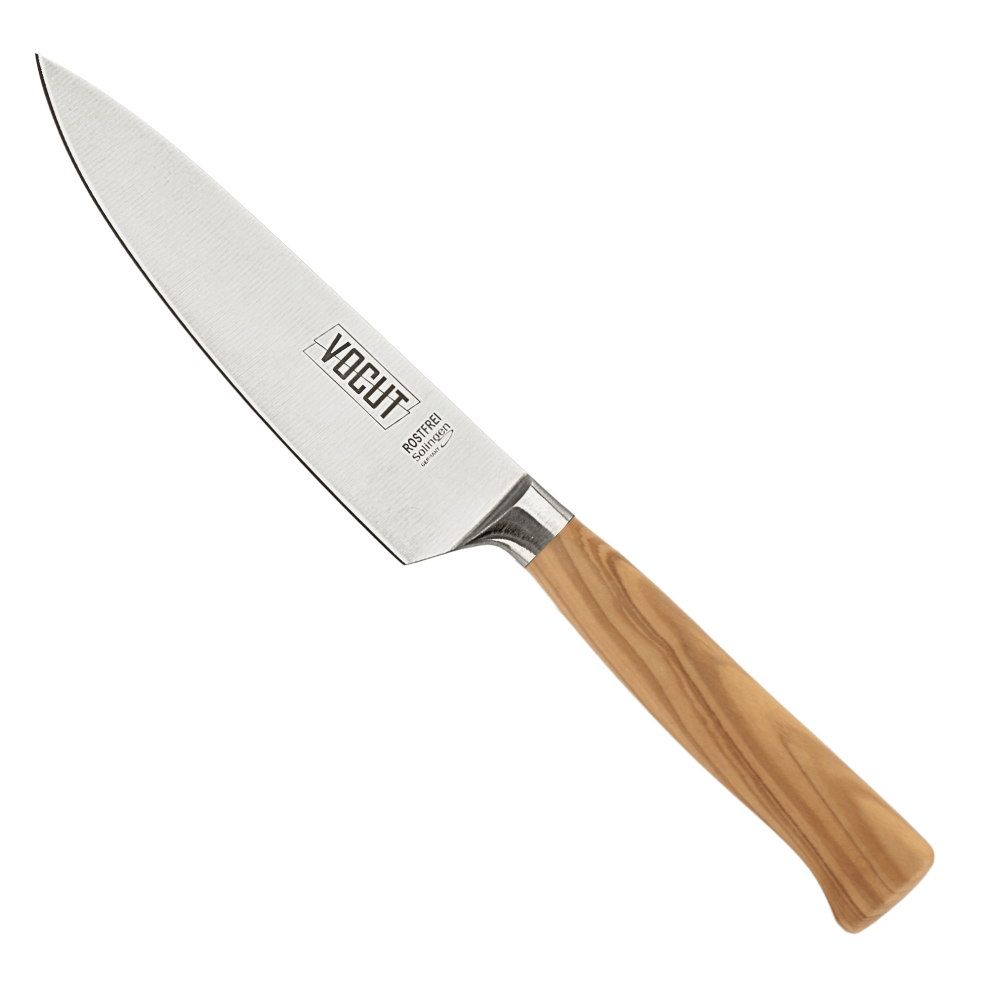

1. The steel: The most important factor. Good knife steel has a hardness rating of 55–62 HRC (Rockwell). Stainless steel (e.g. 1.4116 / X50CrMoV15) is easy to maintain and ideal for everyday use. Harder steels (60+ HRC) hold an edge longer but are more brittle and prone to chipping.
2. Manufacturing – forged vs. stamped: Forged knives are shaped from a single piece of steel through hammer blows. The result is a more uniform steel structure, better balance, and longer edge retention. Stamped knives are cheaply cut from steel sheets.
3. Balance: The knife should feel balanced at the bolster (the transition point between blade and handle), neither tipping towards the tip nor the handle. Test: balance the knife horizontally on one finger at the bolster.
4. Handle: The handle must feel secure in your hand – even when wet. Olive wood provides natural grip and looks beautiful; plastic handles are more hygienic for professional use.
5. Origin: “Made in Solingen“ is legally protected – it cannot simply be bought or faked. It means verifiable production in the blade city with centuries of experience.
The classic beginner's knife is either a Santoku or a chef's knife in the 8-inch version. Both handle 90% of everyday cutting tasks perfectly.
Why not start with Japanese knives? High-end Japanese knives (e.g. with single-bevel edge or 62+ HRC) are extremely sharp but also more delicate: they chip at bone contact or lateral pressure, require diamond whetstones for sharpening, and demand specific cutting techniques. As a first knife, they're unnecessarily demanding.
Common beginner mistakes:
- Buying a cheap set that's blunt after 6 months
- Buying an exclusive Japanese knife before mastering basic technique
- Never sharpening the knife and wondering why it “doesn't cut anymore“
Price categories at a glance:
- Under €30: Stamped blades, soft steel (~50–52 HRC), goes blunt quickly, barely resharpenable. Acceptable for occasional use.
- €30–80: A good entry point. Stainless steel, 55–57 HRC, solid construction. Solingen knives in this price range are often already handcrafted.
- €80–200: Hand-forged quality from Solingen. Steel at 58–60 HRC, good balance, long-lasting. The price range for people who cook regularly.
- €200–500: Professional and artisan quality. Special steels, Damascus steel, premium handle materials. For passionate cooks and collectors.
The honest answer to “is it worth it?“: A good knife at €100 costs less than 3 cents per day over 10 years of daily use. The pleasure and safety it brings to cooking is priceless. Browse our bestselling knives.
A personalised knife is a gift that's genuinely used every day – not a decorative piece gathering dust on a shelf. To make the gift truly impressive:
- Choose laser engraving, not chemical etching: Laser engraving permanently removes material with precision. It won't fade, won't rust, and largely survives resharpening. Chemically etched engravings can fade over time.
- Knife quality comes first: A beautiful engraving on a poor knife is still a poor gift. The knife itself must impress.
- What to engrave? A name, initials, date, a short message, coordinates of a special place, or a nickname. Maximum 1–2 lines for best legibility.
- Factor in delivery time: With engraving, typically 2–5 working days additional processing time. Order in good time!
A grilling enthusiast wants a knife that actually gets used. The best gift options:
- BBQ knife (22 cm): Long, stable blade for carving at the grill.
- Butcher's knife: For those who break down and portion their own meat – professional quality that makes an impression.
- Steak knife set (4 or 6 piece): For the whole table – looks fantastic when serving and elevates the steak experience entirely.
Combined with a personal engraving (e.g. “Grill Master 2024“ or simply the recipient's name), this becomes an unforgettable gift for birthdays, Christmas, or Father's Day.
Contrary to the widespread belief, most professional chefs do not use enormous knife cases with 30 blades. The reality in commercial kitchens:
- The chef's knife is used for 70–80% of all cutting tasks – it is the most important knife by far.
- The filleting knife is in daily use wherever fish or meat must be filleted.
- The paring knife for detailed work, garnishing, and smaller ingredients.
- The boning knife is indispensable in butchery and meat preparation.
Well-known preferences: renowned chefs swear by German manufacturers such as Güde, Wüsthof, and Herder – all from Solingen. In professional gastronomy, robustness and resharpenability are valued above all.

The bread knife is the only kitchen knife where you deliberately choose against a smooth edge. The serrated edge works like a fine saw: it grips the hard crust and draws through without needing to apply pressure to the soft bread.
Why length matters: A blade that's too short (under 20 cm) forces you to use many small sawing movements, which tears the bread. A 21–23 cm blade glides cleanly through any loaf in just a few long strokes.
What else is the bread knife good for? Tomatoes (hard skin, soft interior), pineapple, watermelon, hard squash skin, and cakes with a sugar crust.
Meat: The classic chef's knife (8–9 inches) is the all-rounder for raw and cooked meat. For professional boning: a boning knife with a narrow, slightly curved blade. For large roasts and poultry: a carving knife with a long, narrow blade.
Fish: The filleting knife has a thin, flexible blade (6–8 inches) that conforms to the fish body and allows paper-thin slices. A rigid knife would leave unnecessary amounts of flesh on the bone.
For grilled food: The BBQ knife with 22 cm blade – strong enough for a whole roast, precise enough for clean slices at the table.
Damascus steel knives are undeniably visually captivating: the typical wave and flame patterns are created by alternately folding and forging different types of steel. But what many people don't realise:
In most “Damascus knives“ on the market, the Damascus steel consists only of the outer cladding layers – purely decorative. The actual cutting core in the centre is a mono steel (e.g. VG-10 or X50CrMoV15). The knife cuts exactly as well as this core steel – regardless of whether 33 or 200 Damascus layers surround it.
True full Damascus (all layers are cutting steel) is rarely found in knives at €150–300. In €50 “Damascus knives“ from the internet, it essentially never exists.
Conclusion: A quality Damascus knife is a worthwhile investment for those who value aesthetics and craftsmanship. As a pure cutting tool, a high-quality Solingen mono-steel knife is often the better choice.
Reliable home tests:
- Paper test: Hold a sheet of copy paper vertically and draw the knife through it with a light pulling motion. A sharp knife cuts cleanly through the paper – no tearing, no snagging.
- Tomato slice test: Place a ripe tomato on the cutting board, rest the knife on top, and slice using only gravity (no pressing). A sharp knife glides through the skin without crushing it.
- Fingernail test: Very carefully draw the knife across your thumbnail. A sharp knife gently “catches“ on the nail – a dull one slides straight off. Use the lightest possible touch!
- Light test: Hold the blade under a light source and look at the edge. A sharp knife reflects almost no light. Dull spots appear as bright, reflective lines.
The difference from a regular table knife is enormous: a standard cutlery knife has a serrated edge that pushes the meat apart rather than cleanly slicing it. A steak knife with a smooth, sharp blade severs the muscle fibres without pressure – the result is a perfectly clean cut and a noticeably better flavour experience (less meat juice escapes).
When a steak knife set is worthwhile: Anyone who regularly serves good meat makes a lasting impression with a quality set from Solingen. The set should look visually cohesive – olive wood handles in a set of 4 or 6 create a beautiful table presentation.

The BBQ knife combines the strengths of a chef's knife (length, stability) with the specific needs of grilling: the long blade allows long, gliding cuts through large pieces of meat in a single stroke – no readjusting. This avoids the typical shredding that occurs when sawing with a short knife.
Uses at the grill:
- Carving whole chickens and poultry
- Slicing brisket and large roasts into even portions
- Portioning spare ribs
- Serving grilled vegetables and large fish fillets
The olive wood handle on the VOCUT BBQ knife is not just beautiful – it also provides a secure grip even with slightly greasy, marinaded hands.
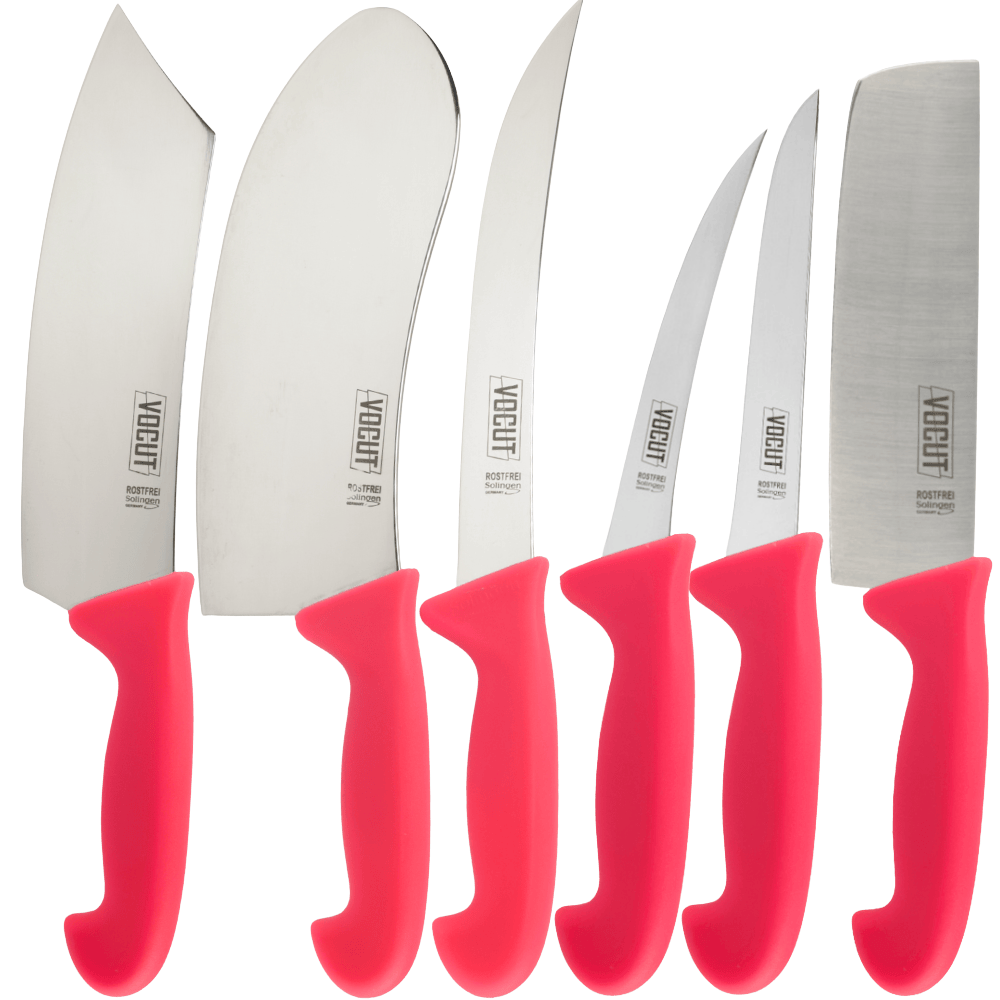
In contrast to the delicate filleting knife, the butcher's knife is built for robustness. The wide, stable blade withstands contact with cartilage and tough sinew. The plastic handle (often coloured) is hygienically easier to clean – a must in professional food processing.
Colours in professional use: In the catering industry, different knife colours are used to prevent cross-contamination: red for raw meat, blue for fish, green for vegetables, white for cheese and pastries. The VOCUT butcher's knife with coloured plastic handle meets this HACCP standard.
The cutting board is almost as important for knife longevity as sharpening itself. The logic is simple: every time the blade meets the board, a microscopically small steel fragment is removed. The harder the board, the more damage.
Recommendation by material:
- Wood (beech, maple, cherry): The most blade-friendly choice. The fibres give slightly and guide the blade gently. Wooden boards are antibacterial with proper care. Downside: cannot be soaked; needs occasional oiling.
- Plastic: More hygienic, dishwasher-safe. Hard polyethylene is gentle on blades. Soft plastic gets cut over time and becomes a bacteria trap.
- Bamboo: Controversial. Bamboo is very hard and damages knives more than wood. Looks attractive but not functionally ideal.
- Glass, stone, ceramic, metal: Absolute no-go. A single use can irreparably blunt a high-quality blade.
A knife's lifespan depends almost entirely on how it's cared for, not the passage of time. A quality Solingen steel (1.4116, 56–60 HRC) doesn't simply deteriorate over time – it is only damaged through mistreatment.
What shortens knife lifespan:
- Dishwasher use (corrodes the steel, damages the handle)
- Hard cutting surfaces (glass, stone)
- Storing when wet (rust at the blade-handle junction)
- Never sharpening (the knife dulls but doesn't break)
VOCUT resharpening service: Even if a VOCUT knife has deep grinding marks or has gone completely blunt after years of use – it can be professionally resharpened and returned to new condition. That's the purpose of the lifetime resharpening service: a knife that stays with you forever.
Method 1 – Honing steel (for regular maintenance, daily to weekly):
- Stand the honing steel vertically with its tip on a cutting surface.
- Place the knife at a 15–20° angle (rule of thumb: a raised thumb between blade and steel is approximately 15°).
- Draw the blade in a slight arc along the steel from handle to tip.
- Repeat on the other side of the steel. 5–10 times per side.
- No pressure needed – only the weight of the knife is sufficient.
The honing steel realigns the cutting edge, which bends slightly during use – it does not remove metal. The knife must still have some sharpness; a completely blunt knife cannot be rescued by a honing steel alone.
Method 2 – Whetstone (for dull knives, every 3–6 months):
- Soak the whetstone for 5–10 minutes (grit 800–1000 for initial sharpening).
- Place the stone on a damp cloth to prevent slipping.
- Hold the knife at a consistent 15–20° angle and push the blade away from you across the stone.
- Work one side completely until a slight burr forms (felt when running a finger across the edge).
- Switch sides until the burr transfers to the other side.
- Refine on a finer stone (2000–3000 grit), then strop on leather or a ceramic rod.
The sharpening angle directly influences how sharp the knife becomes and how long it holds that sharpness:
- Smaller angle (10–15°): Very sharp, thin edge – but more sensitive to lateral pressure and hard materials. Typical of Japanese knives.
- Larger angle (20–25°): More robust edge, handles lateral stress better – marginally less sharp. Typical of butcher's knives and robust everyday knives.
- 15–20° (Solingen standard): The best balance of sharpness and robustness for everyday use.
Important: if a knife is resharpened at a different angle from the original, it takes a long time to establish the new angle fully – steel must be removed layer by layer. This is why it's always best to maintain the original sharpening angle, or hand the knife to a professional sharpening service.
The frequency depends heavily on how intensively the knife is used and what it cuts:
- Daily use in a professional kitchen: Honing steel daily, whetstone weekly to monthly, professional sharpening every 3–6 months.
- Regular home cooking (4–5 times/week): Honing steel after each use, whetstone every 3–4 months.
- Occasional cooking (1–2 times/week): Honing steel weekly, whetstone 1–2 times per year.
The best signal is the knife itself. When the tomato no longer glides without pressure, or bread tears instead of slices cleanly – it's time to sharpen. Go by feel, not by the calendar.
Grit and their purposes:
- 120–400 grit (coarse): For heavily damaged or very dull knives. Removes a lot of material – use only when necessary.
- 800–1200 grit (medium): Initial sharpening for dull knives. The most important grit for everyday use.
- 2000–3000 grit (fine): Refinement after initial sharpening. Creates a smoother, sharper edge.
- 6000–8000 grit (very fine): Polishing level, for maximum and razor sharpness. For enthusiasts.
The steel must stay wet during sharpening – either with water or sharpening oil. Some stones need soaking (5–10 minutes in water), others only need to be kept moist. Always follow the manufacturer's instructions.
The terms are often used interchangeably, but they mean technically different things:
Honing (stropping): The fine cutting edge bends microscopically during use – like a blade of grass in the wind. The honing steel realigns this bent edge back to straight, without removing any metal. Very quick (10–20 seconds), maintains existing sharpness.
Sharpening (grinding): When the cutting edge is no longer just misaligned but truly blunt or damaged, material must be removed. The whetstone grinds a new, sharp edge. Takes longer (5–20 minutes), fundamentally restores sharpness.
The correct sequence: sharpen (when necessary) → then hone → finished. Honing alone without prior sharpening won't help a genuinely blunt knife.
Ceramic blades (zirconium oxide) are at approximately 80 HRC extremely hard – far harder than any steel. This makes them stay sharp for a long time, but also impossible to sharpen with normal means:
- Regular honing steels and whetstones are too soft – they have no effect on ceramic
- Only diamond sharpeners (the only material harder than ceramic) work
- These are expensive and require practice and skill
A further disadvantage of ceramic knives: they shatter like porcelain under lateral pressure or if dropped on a hard floor. For this reason they haven't become established in professional kitchens. As a supplement to a Solingen steel knife for vegetable cuts, they can be useful.
The serrated edge consists of small, regular waves (peaks and valleys) along the blade. Each individual wave has its own small cutting edge – to sharpen all of them evenly, you need a tapered ceramic rod that is inserted individually into each serration.
For home use, there are special ceramic sharpening rods for serrated edges (e.g. from Spyderco) – this requires patience but works well.
Easier and recommended: have the bread knife professionally sharpened once a year. Since the serrated edge dulls very slowly and bread is a gentle cutting material, this is usually completely sufficient.
Signs that professional sharpening is needed:
- The knife barely responds to the honing steel – the steel can only maintain sharpness, not create new sharpness
- Visible chips, notches, or deformations in the edge (e.g. from bone contact or being dropped)
- The blade shows a slight wave or uneven edge from repeated self-sharpening
- The sharpening angle has drifted from repeated home sharpening
What happens in the dishwasher when olive wood goes in: the hot water (55–70°C) combined with aggressive detergents and steam causes the wood to repeatedly swell and shrink. This process:
- Cracks the wood surface and creates splits
- Loosens the bond between handle and blade (rivets, adhesive)
- Destroys the natural oils in the wood that keep it supple and hygienic
- Ultimately causes the handle to split or form hygiene traps
Correct cleaning: Immediately after use, wash briefly with lukewarm water and a small drop of washing-up liquid. Wet the handle only briefly. Dry immediately with a cloth and don't leave lying on a wet draining rack.
Olive wood is a dense, natural hardwood with beautiful grain – but it needs regular care to remain durable and hygienic.
Step-by-step care routine:
- Ensure the knife is completely dry (the handle must be bone dry before oiling)
- Apply a tiny drop of linseed oil, olive oil, or mineral/wood oil to a soft cloth
- Rub the entire handle thoroughly – paying special attention to the end grain and the area around the rivets
- Leave to absorb for 5–10 minutes
- Wipe off all excess oil completely – an oil-slick handle is slippery and attracts dirt
Which oil is best?
- Linseed oil (cold-pressed): The best care oil for wooden handles. Linseed oil polymerises as it dries and forms a protective layer in the wood. Allow 24 hours to cure. Use in a well-ventilated space (linseed oil-soaked rags can self-ignite).
- Mineral oil / baby oil: Doesn't go rancid, very easy to apply, good for food contact. Penetrates deeply into the wood. Great for regular, low-maintenance care.
- Cutting board oil: Specifically developed for food contact, on mineral or plant base. Highly recommended.
- Olive oil, rapeseed oil: Works well short-term. Can become slightly rancid over months – smells unpleasant over time. In very small amounts, harmless.
The golden rule of knife care: a knife is cleaned immediately after use – not later in the evening when you “get round to it“. Acidic foods (citrus fruits, vinegar, tomatoes) and salty dishes can attack even stainless steel when left too long.
Step by step:
- Warm (not hot) water with a little washing-up liquid
- Wipe with a soft cloth or sponge from the spine towards the edge – never drag your hand along the cutting edge
- Immediately dry with a clean kitchen cloth
- Store upright in a knife block or on a magnetic strip – never store wet or damp
What to avoid: Soaking knives in water (damages handle), scrubbing with steel wool (scratches the blade), brushing hard scrubbers along the cutting edge.
The three best storage options:
- Magnetic knife strip: The most elegant solution. Knives hang freely without contact with other knives or hard surfaces. Blades stay sharp the longest. Visually stunning in any kitchen. Important: choose a magnetic strip with a wood or plastic surface – bare metal strips can scratch blades.
- Wooden knife block: Classic and functional. Always insert knives with the edge facing upward (don't lower them edge-first – this dulls them). Clean the block regularly with a vacuum cleaner.
- Individual blade guards: Ideal for transport, drawer storage, or camping. Inexpensive and effective.
What to avoid:
- Loose in the cutlery drawer – blades rub against each other and dull rapidly
- Storing when wet – corrosion risk at the blade-handle junction
- Lying flat on hard surfaces
Even “stainless“ steel (X50CrMoV15 / 1.4116) can develop light rust spots – particularly from:
- Prolonged exposure to acidic foods
- Storing when wet (especially at the blade-handle junction)
- Dishwasher use
- Tap water with high chlorine content
Home remedies for light rust:
- Cork stopper + a little cooking oil: circular movements directly on the rust spot
- Baking soda + a little water made into a paste, rubbed in with a soft cloth
- Toothpaste (without abrasive granules) on a soft cloth
After rust treatment: rinse the knife thoroughly, dry completely, and apply a thin film of oil as corrosion protection.
Protecting knives during transport is equally important for the knife (no blade damage) and for personal safety (no cut injuries when reaching into bags).
- Individual sheaths: The cheapest option, ideal for 1–2 knives. Available in leather, felt, plastic, wood. For everyday use and in rucksacks.
- Knife roll / case: For 6–12 knives, in leather or canvas. Standard in the catering industry for bringing personal knives to work.
- Hard-shell case: For professional transport of large knife collections.
Travel tip: On aeroplanes, carrying knives in hand luggage is prohibited. Kitchen knives are permitted in checked baggage – the blade must be covered (use a sheath!). Always check current airline regulations before travelling.
Olive wood is a natural material and behaves accordingly – every handle is a unique piece with its own grain. Over time:
- The colour may deepen: Particularly with regular oiling, olive wood darkens and develops a rich, warm brown tone. This actually makes the knife look even more beautiful.
- The grain becomes more defined: The structure of the wood becomes more visible over time.
- Small signs of use may appear: Micro-scratches from daily use are completely normal and give the knife its “lived-in“ character.
What to avoid: strong, uneven colour change from moisture absorption. This happens when the knife is frequently wetted or too rarely oiled. With regular care (monthly oiling), olive wood remains beautiful for decades.
Oil comparison:
- Linseed oil (cold-pressed): The best care oil for wooden handles. Linseed oil polymerises as it dries, forming a protective layer in the wood. Allow patience – it takes 24 hours to cure. Use in good ventilation (linseed oil-soaked rags can self-ignite).
- Mineral oil / baby oil: Never goes rancid, very easy to apply, excellent for food contact. Penetrates deeply into the wood. Perfect for regular, uncomplicated care.
- Cutting board oil: Specifically designed for food contact, in mineral or plant base. Highly recommended.
- Beeswax paste: As a supplementary sealant after oiling – forms a water-resistant protective layer on the surface. Very effective.
Even “stainless“ steel rusts under unfavourable conditions. The term “stainless“ technically means “corrosion-resistant“ – not rust-proof. The chromium content in the steel (min. 13% in 1.4116) protects the blade through an invisible oxide layer that regenerates on contact with oxygen.
The most common causes of rust:
- Storing when wet (especially the blade-handle junction)
- Dishwasher chemicals (attack the oxide layer)
- Direct salt contact over a prolonged period
- Acidic foods (citrus fruits, tomatoes, vinegar) left on the blade
Corrosion protection for long-term storage: For longer periods of non-use (more than 2–3 weeks), apply a thin coat of vegetable oil or camellia oil to the blade and store in a protective sheath.
Safe disposal of an old knife protects refuse workers and others from cut injuries:
- Wrap the knife securely: thick cardboard (e.g. old packaging), multiple layers of newspaper, then fix firmly with wide tape
- Label clearly: “Caution – Knife / Sharp blade“
- Place in general waste (not metal recycling – this is sorted by hand and would be dangerous)
- Alternative: take to a recycling centre and place in the metal container there
Before disposing of an old knife: is resharpening worthwhile? Quality knives from Solingen can be fully restored through professional sharpening – this is more sustainable and often cheaper than buying a replacement.
The designation “Made in Solingen“ is protected by the Solingen Act of 1938 (updated 1994) and is monitored by the Solingen Cutlery Makers Guild. What this means in practice:
- All essential manufacturing steps must actually be carried out in Solingen: forging or stamping the blade, hardening, grinding, and sharpening the edge
- Packaging a Chinese knife in Solingen and selling it as a “Solingen knife“ is illegal
- The designation is regularly enforced in the courts
Solingen has been called “The City of Blades“ for centuries – the city has been producing knives, scissors, and blades since the Middle Ages and is recognised worldwide as synonymous with knife-making mastery. No other place name on a knife carries this same guaranteed quality significance.
The thinking behind it: a quality knife should not be thrown away when it goes blunt. With the lifetime resharpening service, every VOCUT knife becomes a tool for eternity.
How it works:
- Pack the knife securely (protect the blade, include your contact details)
- Send to VOCUT in Solingen
- We sharpen the knife professionally to the original sharpening angle and condition
- We return it to you
This applies to all VOCUT knives – without time limit, without restrictions on frequency, for life. Even if the knife is passed on to the next generation, the claim to the service remains valid.
This service is a clear expression of our conviction: quality that lasts. Not throwaway culture, but a knife for life.
Laser engraving technology allows precise, controlled engravings on the knife blade or handle:
- What can be engraved: Names, initials, dates (e.g. wedding anniversary), short messages, logos, symbols, GPS coordinates
- Where engraving is applied: On the blade surface (visible during use) or on the handle depending on the model
- Durability: The engraving is permanent – it won't fade, won't rust, and survives sharpening and care processes
- Delivery time: 2–4 additional working days on top of standard delivery time
What makes a great engraving? Less is more. Maximum 1–2 lines for best legibility. Clean lettering without excessive flourishes. A single name in an elegant font often has more impact than a long sentence.
Solingen knives (European tradition):
- Steel 55–60 HRC – optimal for everyday use
- Stainless steel – no special maintenance programme needed
- Resharpenable with a normal honing steel and standard whetstone
- More robust against lateral pressure and hard cutting material
- The more straightforward choice for home cooks
Japanese knives:
- Often 60–65+ HRC – extremely sharp, holds an edge longer
- But: more brittle, chips more easily under lateral pressure (avoid rocking motion!)
- Often not stainless (carbon steel) – requires intensive care
- Only sharpenable with diamond or water stones, not a standard honing steel
- Ideal for experienced cooks using Japanese cutting techniques
Many professional chefs use both: Solingen knives for robust everyday cooking, Japanese knives for fine work and special moments at the stove.
The designation of origin is the only reliable guarantee. Further indicators of genuine quality:
- Seamless connection between blade and handle – no gap, no movement or looseness
- Even grind without scratches or irregularities along the cutting edge
- Balance: The knife feels well-balanced in the hand – neither blade nor handle pulls down
- Manufacturer information: Reputable manufacturers state production details, steel specification, and stand by name behind their product
Be cautious of: Knives without a manufacturer's name, without steel specification, from dubious online sources at rock-bottom prices. “Solingen style“ or “Solingen design“ is NOT a designation of origin!
Most knife manufacturers purchase finished handles from suppliers – standardised parts without individual character. VOCUT does things differently:
Orazio Vella sources solid olive wood blocks and saws the handles to shape himself. This means:
- Every handle has a unique grain pattern – no two VOCUT knives look exactly alike
- The raw density and quality of the wood can be controlled and checked
- No industrial uniformity pressure – the result is honest craftsmanship
Olive wood itself is one of the densest and hardest woods used for knife handles. The characteristic light golden to dark brown grain with its swirls and flames makes every handle a small work of art.
Steel 1.4116 (X50CrMoV15) – properties in detail:
- Hardness: 56–58 HRC – optimal for everyday knives. Hard enough for good edge retention, soft enough to be resharpenable with a standard whetstone
- Stainless: Min. 15% chromium content makes the steel corrosion-resistant – even with acid contact and damp storage
- Resharpenable: Can be sharpened effortlessly with any honing steel and whetstone
- Blade flexibility: Slightly more flexible than harder steels – less risk of chipping under lateral pressure
- Solingen processing: The steel is hardened and finished in Solingen – this makes the qualitative difference from identically-labelled steel produced elsewhere
The laser engraving is carried out directly in Solingen – once an order with an engraving request is received, the knife is individually engraved, inspected, and then dispatched.
Important for gifts: Order in good time! Particularly during the pre-Christmas period (mid-November to mid-December), processing time may extend to 5–7 working days. For birthdays and weddings: allowing 10–14 days buffer is always safer than leaving it to the last minute.
Standard deliveries without engraving typically arrive within 1–3 working days (free shipping within Germany). Order a knife with engraving now →
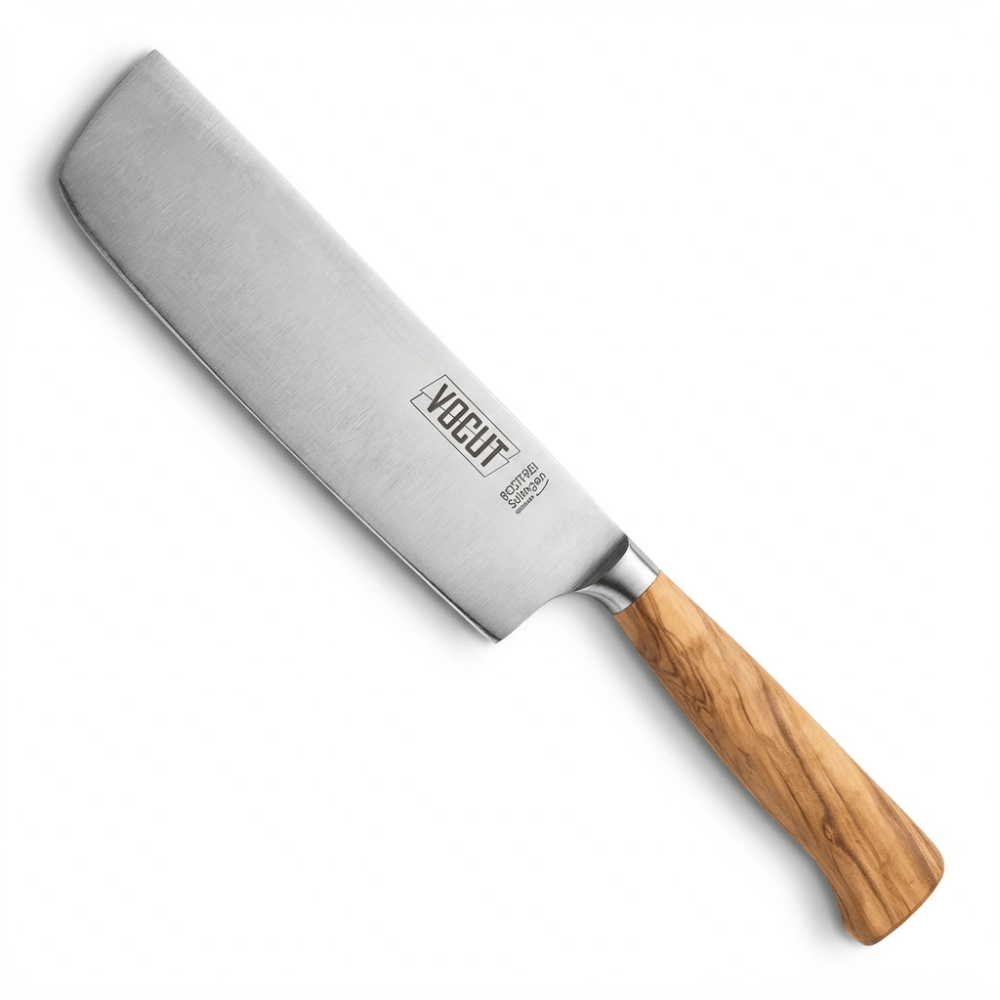
The Nakiri is the second most popular Japanese-inspired knife in home kitchens after the Santoku. Its key features:
- Rectangular blade: The blunt tip (no classic pointed tip) is intentional on the Nakiri – it is not a design flaw
- Straight edge: The Nakiri works with a pure push cut (straight down) – no rocking motion like a chef's knife
- Wide blade: Acts as a spatula – cut vegetables rest directly on the blade and can be pushed into the pot or pan
- Reduced injury risk: Due to the absent tip and typical cutting technique
Who is the

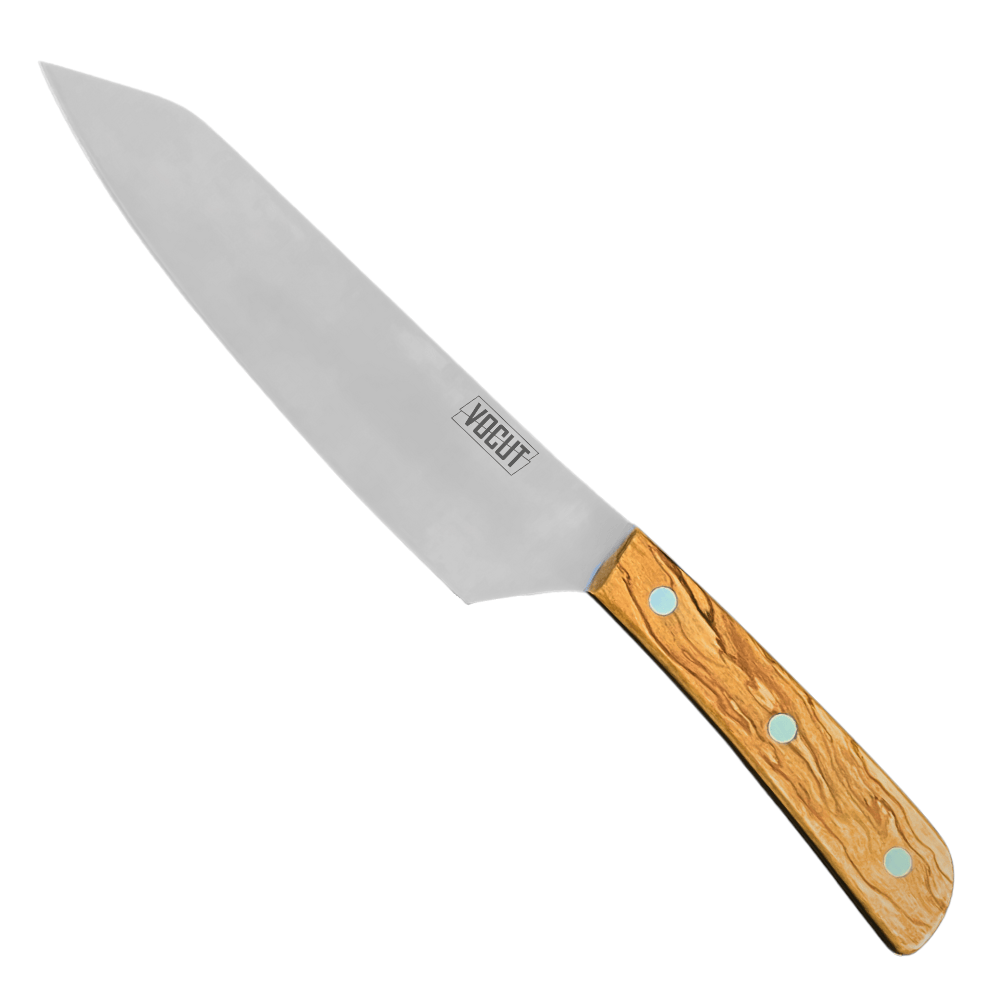
The Kiritsuke is traditionally considered the chef's knife in Japan – in classical Japanese kitchens, only the head chef would use this knife. Today it is more accessible:
- K-Tip (tanto point): The angled, angular tip is the defining feature. It allows precise tip work such as herb dicing while also enabling the wide-surface cutting typical of a Nakiri
- Versatility: Can be used like a Yanagiba (for sashimi, thin fillets) and like a Nakiri (for vegetables)
- For the experienced cook: The unusual tip profile requires a little adjustment time
Rockwell hardness (C-scale) measures a material's resistance to indentation. For knives this means:
- 50–54 HRC: Soft steel – cheap knives, dulls quickly, very easily resharpenable. Typical of supermarket knives.
- 55–58 HRC: Solingen standard. Good edge retention, robust, easy to sharpen with a honing steel and standard whetstone. Ideal for everyday use.
- 59–62 HRC: High-quality range. Very long-lasting sharpness, but slightly more brittle blade. For experienced knife users.
- 63–66 HRC: Japanese premium class. Extremely sharp and long-holding edge, but chips under lateral pressure or bone contact. Only sharpenable with diamond or water stones.
Higher hardness is not automatically “better“ – it comes with trade-offs. For home kitchens, 56–58 HRC offers the best balance of sharpness, robustness, and ease of maintenance.
The confusion is widespread and understandable, as both terms are often used interchangeably. Technically correct:
- Kitchen knife: The overarching category. Covers all knives used in the kitchen – from the small paring knife to the large chef's knife, from the bread knife to the filleting knife.
- Chef's knife: A specific knife form within the kitchen knife family. Characteristic: 8–10 inch blade, tapering to a point, curved edge for the rocking motion, balanced weight between blade and handle.
The chef's knife is the most versatile and important within the kitchen knife family – when someone says they want “a kitchen knife“, they usually mean a chef's knife.
The serrated edge was invented in 1926 by Karl Güde in Solingen and revolutionised bread cutting: for the first time, fresh bread could be sliced cleanly without crushing the soft crumb.
How it works: The wave-shaped peaks grip the hard surface (bread crust, tomato skin) and “saw“ through it, where a smooth edge would simply slide off.
When a serrated edge is useful:
- Bread and rolls with a hard crust
- Tomatoes (tough skin, soft interior)
- Pineapple, watermelon, squash
- Cakes and desserts with a hard sugar glaze
When a serrated edge is NOT suitable: For meat, fish, and raw vegetables a smooth edge is better – the serrated edge shreds meat rather than making a clean cut.
Forged knives (Solingen tradition):
- The steel billet is heated (approx. 1100°C) and shaped through hammer blows
- Forging densifies the steel structure – more uniform grain, better edge retention
- Blade and handle emerge from a single piece of steel (full tang) – this creates the characteristic balance
- The bolster (blade reinforcement at the handle transition) is integral – not a glued-on part
- More expensive to produce, but significantly more durable
Stamped knives:
- A steel sheet is stamped like cookie cutters – the blade shape is cut out
- Cheaper, faster, suited to mass production
- Lighter (no bolster), thinner, less robust
- Perfectly adequate for occasional use
All VOCUT knives are forged – for us this is not an option but the standard. Discover forged VOCUT knives →
The designation explained: X50 = 0.5% carbon, Cr = chromium (14–15%), Mo = molybdenum, V = vanadium. This alloy produces:
- Stainlessness: Min. 13% chromium content forms a stable oxide layer that prevents corrosion
- Hardness 56–58 HRC: Good edge retention for everyday use, resharpenable with standard equipment
- Molybdenum: Further improves corrosion resistance and increases toughness
- Vanadium: Forms fine carbides in the steel – improves the cutting edge and grindability
Why, despite identical steel designations, there's a difference between cheap and expensive knives: the quality of the heat treatment (hardening, tempering) makes the difference. Solingen workshops have centuries of experience in blade hardening – this cannot be replicated elsewhere.